+971 55 586 7466
EN|AR
HomeConditionsAyurveda for Arthritis in Dubai
AYURVEDA FOR ARTHRITIS · DHA-LICENSED CLINIC IN JVC, DUBAI

"Arthritis" describes fifteen different diseases. Your treatment should reflect which one you have.

Authentic Ayurvedic treatment for arthritis in Dubai begins with identifying which type — osteoarthritis, rheumatoid arthritis, gout, ankylosing spondylitis, frozen shoulder, psoriatic arthritis. Each has different Ayurvedic protocols, different realistic outcomes, and different roles for conventional rheumatology. At our Jumeirah Village Circle (JVC) clinic, structured 3 to 9-month programmes combine Panchakarma, localised joint therapies, internal medicines, and integrated physiotherapy — working alongside your rheumatologist or orthopaedic specialist.
Ayurvedic doctor examining knee joint range of motion at Vedara Care JVC clinic Dubai

EXAMINATION FIRST, TREATMENT SECOND.

Range of motion assessment, joint examination, inflammatory pattern review. The treatment plan follows from what we find.

We Work With Your Rheumatologist
450+ Arthritis Patients Treated
Integrated Ayurveda + Physiotherapy
Walking Distance from Circle Mall, JVC

THE QUICK ANSWER

Ayurvedic arthritis treatment in Dubai, in one paragraph.

Ayurvedic treatment for arthritis in Dubai is a 3 to 9-month structured medical programme combining classical Panchakarma protocols (typically Virechana for inflammatory patterns; Basti for Vata-pattern joint disease), localised joint therapies (Janu Vasti for knees, Greeva Vasti for cervical, specific protocols for shoulders and other joints), Njavarakizhi (medicated rice bolus therapy for muscle and joint nourishment), internal Ayurvedic medicines (typically including Dashamoola, Yogaraja Guggulu, Maharasnadi Kashayam, Sahacharadi formulations), dietary regulation, and integrated physiotherapy where indicated. At Vedara Care Polyclinic in Jumeirah Village Circle (JVC), Dubai — next to Circle Mall — protocols are specific to your arthritis subtype and work alongside rheumatology or orthopaedic care. Initial consultations start from AED 350.

Medically reviewed by Dr. Priya Menon, BAMS, MD (Ayurveda), DHA-Licensed · Last updated June 2026

TYPE MATTERS

Seven major arthritis types. Each has different Ayurvedic treatment.

The single biggest reason Ayurvedic arthritis treatment underperforms is treating all arthritis types identically. At our JVC clinic, identifying your specific type is the foundation of an effective protocol.

A

Osteoarthritis (Degenerative)

Sandhivata in classical Sanskrit

The most common arthritis type. Wear and tear degeneration of joint cartilage, typically affecting knees, hips, spine, and small finger joints. Onset usually after age 45. Pain worsens with use, improves with rest. Common in JVC's older population. Ayurvedic treatment is particularly valuable for pain management, joint mobility, slowing progression, and improving quality of life. Sometimes delays the timing of joint replacement.

Ayurvedic emphasis for this type:

Janu Vasti for knees, Vata-pacifying Panchakarma, Yogaraja Guggulu, Njavarakizhi for muscle support, integrated physiotherapy
B

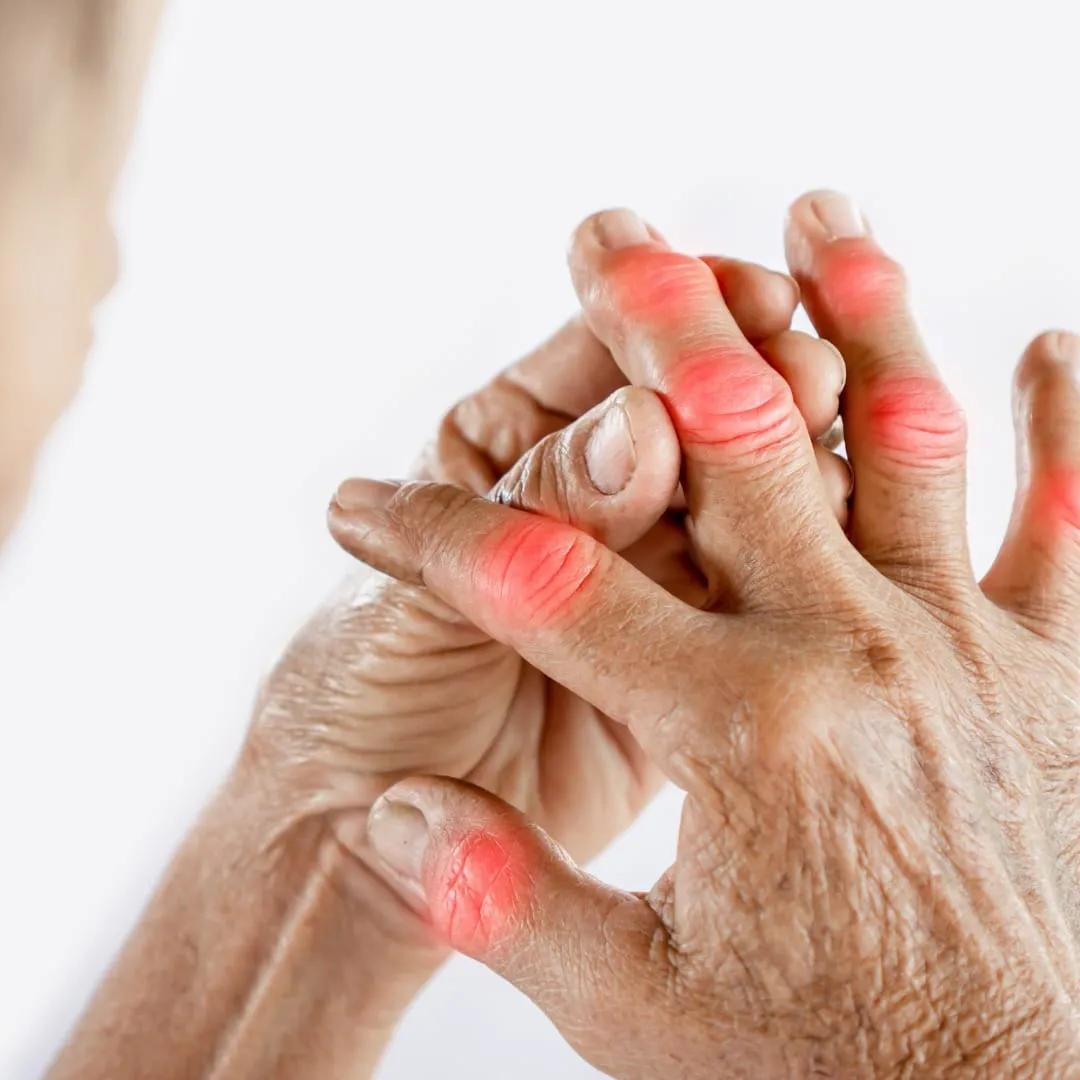
Rheumatoid Arthritis (Inflammatory Autoimmune)

Amavata in classical Sanskrit

Autoimmune inflammatory arthritis affecting small joints symmetrically, typically hands, wrists, feet. Morning stiffness exceeding one hour is characteristic. Onset usually 30-60, female predominance 3:1. Requires ongoing rheumatology care including DMARDs (methotrexate, leflunomide) and often biologics (adalimumab, infliximab, tocilizumab). Ayurvedic treatment provides supportive care — pain modulation, joint protection, immune balance support — never replacing immunosuppressive medications.

Ayurvedic emphasis for this type:

Amavata-specific protocols, Yogaraja Guggulu, dietary regulation (specific anti-Ama protocols), gentle Panchakarma, rheumatology coordination throughout
C

Gout (Crystalline)

Vatarakta in classical Sanskrit

Inflammatory arthritis from monosodium urate crystal deposition. Acute attacks of severe joint pain — classically big toe, but any joint. Predominantly affects men 40+, women post-menopause. Linked to hyperuricaemia, diet, alcohol, and metabolic syndrome. Ayurvedic treatment particularly valuable for prevention, lifestyle modification, and acute attack management — alongside allopurinol or colchicine where prescribed.

Ayurvedic emphasis for this type:

Pitta-Vata pacification, dietary protocols (specific anti-Ama, low-purine principles), Punarnava-based medicines, lifestyle modification, integration with conventional uric acid management
D

Ankylosing Spondylitis (Spinal Inflammatory)

Asthi-Majja Gata Vata patterns

Inflammatory arthritis primarily affecting the spine and sacroiliac joints. Typically men 20-40, characteristic morning stiffness, gradual fusion of spinal vertebrae over years. Strong HLA B27 genetic association. Requires rheumatology care including NSAIDs and often biologics. Ayurvedic treatment provides adjunctive support — pain management, postural protection, quality of life — alongside conventional immunosuppression.

Ayurvedic emphasis for this type:

Pizhichil and Kati Vasti protocols, Vata pacification, postural and movement protocols, rheumatology coordination throughout
E

Psoriatic Arthritis (Inflammatory with Skin Component)

Multiple classical patterns including Vatarakta-Kustha overlap

Inflammatory arthritis associated with psoriasis. Can affect any joint pattern — sometimes RA-like, sometimes spine-predominant, sometimes asymmetric. Complex disease often requiring biologics for both skin and joints. Ayurvedic treatment addresses both components — joint inflammation and skin manifestations — but always alongside dermatology and rheumatology.

Ayurvedic emphasis for this type:

Combined skin-joint protocols, Panchakarma where appropriate, integration with dermatology and rheumatology
F

Frozen Shoulder (Adhesive Capsulitis)

Apabahuka in classical Sanskrit

Distinct condition not strictly arthritis but commonly grouped with arthritis presentations. Progressive shoulder stiffness and pain with limited range of motion. Typically affects 40-60 age group, particularly diabetics. Self-limiting over 12-24 months without treatment but profoundly disabling during active phase. Ayurvedic treatment significantly shortens recovery timeline and reduces pain.

Ayurvedic emphasis for this type:

Specific shoulder protocols including Patra Pinda Sweda, Nasya, internal medicines for Vata pacification, integrated physiotherapy is essential
G

Cervical and Lumbar Spondylosis

Greevasandhigata Vata, Katisandhigata Vata

Degenerative arthritis of the cervical (neck) and lumbar spondylosis. Common in 40+ population, particularly in office workers with poor posture, prevalent in Dubai's expat working population. Different from back pain — involves specific joint and disc degeneration patterns. Often responds well to Ayurvedic treatment combined with physiotherapy.

Ayurvedic emphasis for this type:

Greeva Vasti for cervical, Kati Vasti for lumbar, Vata pacification, postural and ergonomic protocols, integrated physiotherapy

Most patients arrive at our JVC clinic with a clear arthritis diagnosis from rheumatology or orthopaedics. For undiagnosed joint pain, we coordinate with conventional diagnostic workup before designing a treatment plan. Effective Ayurvedic treatment requires accurate diagnosis.

A FUNDAMENTAL DISTINCTION

Inflammatory vs degenerative arthritis — completely different treatment philosophy.

AUTOIMMUNE DISEASE

Inflammatory Arthritis

  • Rheumatoid arthritis, psoriatic arthritis, ankylosing spondylitis, juvenile arthritis
  • These are autoimmune diseases where the immune system attacks joint tissue. They are progressive without treatment, can cause permanent joint damage, and have systemic effects beyond the joints. Modern medicine has transformed these conditions through DMARDs and biologics that genuinely slow or stop disease progression.
  • Conventional treatment is essential — methotrexate, biologics, immunosuppressants are disease-modifying
  • Ayurveda is supportive only — never replaces disease-modifying therapy
  • Rheumatology lead — Ayurvedic doctor coordinates with rheumatologist
  • Goal is supportive care — pain modulation, joint protection, quality of life, adjunctive immune balance
  • What we explicitly do not do — recommend stopping methotrexate, biologics, or other DMARDs
WEAR-AND-TEAR

Degenerative Arthritis

  • Osteoarthritis (knee, hip, spine, hand), cervical and lumbar spondylosis, frozen shoulder
  • These are conditions of cumulative joint wear, cartilage loss, and biomechanical change over time. They are not autoimmune. Modern medicine offers limited disease-modifying treatment — primarily pain management, physiotherapy, joint replacement when severe. Ayurvedic treatment often produces meaningful symptom improvement and may slow progression.
  • Ayurveda can be primary treatment — for many patients, particularly early-to-moderate disease
  • Sometimes delays surgery — joint replacement timing may be deferred meaningfully
  • Strong pain management — particularly with localised therapies like Janu Vasti
  • Combined with physiotherapy — produces best outcomes
  • Orthopaedic coordination essential — for advanced disease and surgical decisions

Confusing these categories — treating rheumatoid arthritis as if it were osteoarthritis or vice versa — produces poor outcomes and sometimes harm. The first step at our JVC clinic is confirming which category your arthritis falls into.

THE TREATMENT APPROACH

Ayurvedic arthritis treatment has four pillars.

1

Localised Joint Therapies

The most clinically distinctive Ayurvedic intervention for arthritis. Specific localised therapies depending on affected joint — Janu Vasti (warm medicated oil reservoir over the knee) for knee arthritis, Greeva Vasti for cervical spondylosis, Kati Vasti for lumbar spondylosis, specific protocols for shoulders, Pizhichil for whole-body arthritis presentations. These therapies deliver medicated oils directly to the affected joint tissue with sustained warmth — typically 30-45 minutes per session, courses of 7-14 sessions.
2

Panchakarma Cleansing

For inflammatory arthritis subtypes (RA, PsA, gout) and complex osteoarthritis with systemic involvement, classical Panchakarma — typically Virechana for inflammatory patterns, sometimes Basti for Vata-pattern joint disease — addresses underlying systemic inflammation. Performed once during the programme, typically months 2-3. Carefully contraindicated in patients on biologics or with active inflammatory flares; coordinated with rheumatology.
3

Internal Medicines for Joint Disease

Specific Ayurvedic medicines selected for your arthritis type and dosha pattern. For osteoarthritis: Dashamoola, Yogaraja Guggulu, Maharasnadi Kashayam. For rheumatoid arthritis: Amavata-specific Yogaraja Guggulu, Simhanada Guggulu, Vaiswanara Churna. For gout: Punarnava-based formulations, Kaishore Guggulu. For ankylosing spondylitis: specific Vata-pacifying combinations. Doses are individualised, adjusted monthly, and reviewed for interactions with conventional medications.
Single-pillar approaches — 'just take this anti-inflammatory herb,' 'just do Panchakarma,' 'just rest the joint' — produce limited results because arthritis involves multiple layers requiring integrated treatment. The 3-9 month programme addresses all four pillars consistently.
ARTHRITIS QUESTIONS

What patients ask before starting Ayurvedic arthritis treatment.

For specific joint treatments (Kativasti for back), see the treatment pages. For back-specific arthritis, see our back pain page. Read about Panchakarma or Read about Physiotherapy in JVC.

Ask the Clinical Team

For osteoarthritis: yes, substantially. Most of our knee, hip, and spine osteoarthritis patients at the JVC clinic see 50-70% reduction in pain and meaningful function improvement over 6 months. For rheumatoid arthritis and other inflammatory arthritis: Ayurvedic treatment is supportive — providing meaningful symptom relief and quality-of-life improvement but never replacing immunosuppressive medications. For frozen shoulder: outcomes are particularly strong, often shortening recovery from 18-24 months to 4-6 months.

No — and any clinic that promises this is being dishonest. Osteoarthritis is a progressive degenerative condition; Ayurvedic treatment can substantially slow progression and manage symptoms but not reverse joint degeneration. Rheumatoid arthritis and other autoimmune arthritis are chronic diseases requiring ongoing management. What sustained Ayurvedic treatment can produce: meaningful pain reduction, function improvement, slowed progression for OA, fewer flares for inflammatory arthritis, reduced medication needs in some cases, and improved quality of life.

Often, yes — particularly for moderate osteoarthritis without severe structural changes on X-ray. Many of our knee OA patients at the JVC clinic significantly delay or sometimes avoid joint replacement through 4-6 month programmes combining Janu Vasti, internal medicines, and physiotherapy. The decision about timing of joint replacement remains your orthopaedic surgeon's; we provide the symptom and function improvement that supports deferring surgery when clinically appropriate.

Fundamentally different. Rheumatoid arthritis is autoimmune disease requiring conventional DMARDs (methotrexate, leflunomide) and often biologics — these are disease-modifying and essential. Ayurvedic treatment for RA is supportive — pain modulation, joint protection, adjunctive immune balance, quality of life. We never recommend stopping RA medications. Osteoarthritis is degenerative; Ayurvedic treatment can be primary therapy for many patients, particularly with strong localised joint therapies and physiotherapy integration.

Yes. Many of our rheumatoid arthritis and ankylosing spondylitis patients are on methotrexate, hydroxychloroquine, biologics (adalimumab, etanercept, infliximab, tocilizumab), or JAK inhibitors. Ayurvedic treatment is compatible. We do not adjust your immunosuppressive medications — that is your rheumatologist's decision based on disease activity, ESR/CRP, and clinical response. We coordinate throughout the programme.

At Vedara Care, initial assessment starts from AED [price]. A standard 4-6 month arthritis programme starts from AED [price]. A comprehensive integrated programme starts from AED [price]. Across Dubai, comprehensive Ayurvedic arthritis programmes typically range from AED 8,000 to AED 25,000. Knee replacement surgery in Dubai typically costs AED 40,000-80,000 — for OA patients potentially delaying or avoiding surgery, the Ayurvedic programme often pays for itself many times over.

Most osteoarthritis patients feel meaningful pain reduction within the first 4-5 sessions of localised therapy (typically 2-3 weeks). For frozen shoulder, range of motion often improves visibly by week 2-3. For rheumatoid arthritis, the supportive effects accumulate over 8-12 weeks. For inflammatory arthritis flares, expect supportive symptom relief but not rapid disease modification.

Our clinic is at [full address] in Jumeirah Village Circle (JVC), Dubai — next to Circle Mall, three minutes from FIVE Jumeirah Village Hotel, and five minutes from JSS Private School. Free patient parking is available. Patients travel to us from across Dubai including JVC, JVT, Al Barsha South, Dubai Sports City, Motor City, Arjan, Dubai Hills, Marina, Downtown, Palm Jumeirah, and Mirdif. For elderly patients with mobility limitations, we also offer home services for some sessions.

READY?

Begin with the assessment that treats your specific arthritis.

If you have been managing arthritis with general "anti-inflammatory" approaches that do not address your specific type, the first useful step is a 60-minute consultation that takes your specific condition seriously. We confirm your arthritis type, examine your specific joints, review your current treatments, and design a 4-9 month programme tailored to whether you have osteoarthritis, rheumatoid arthritis, gout, ankylosing spondylitis, frozen shoulder, or another specific pattern. We coordinate with your rheumatologist or orthopaedic specialist throughout.

Initial consultation from AED 350 · Walking distance from Circle Mall, JVC · Integrated Ayurveda + physiotherapy · Home services available · Insurance direct-billing