You have been managing back pain for too long. The question is no longer how to live with it.
Chronic back pain in Dubai responds well to authentic Ayurvedic treatment when prescribed correctly — Kativasti for lumbar conditions, Abhyanga and Panchakarma for systemic involvement, integrated with physiotherapy where indicated. This page explains which Ayurvedic protocols fit which types of back pain, written by the DHA-licensed Ayurvedic team at Vedara Care Polyclinic, Jumeirah Village Circle.

ASSESSMENT FIRST
We do not prescribe back pain treatment without examination. The wrong protocol for the wrong condition is worse than no protocol at all.
THE QUICK ANSWER
Ayurvedic back pain treatment in Dubai, in one paragraph.
Ayurvedic treatment for back pain in Dubai typically combines Kativasti (warm medicated oil reservoir over the lumbar spine), Abhyanga (full-body warm oil massage), specific internal Ayurvedic medicines selected for your dosha and condition, dietary regulation, and where appropriate, classical Panchakarma protocols. At Vedara Care Polyclinic in Jumeirah Village Circle, our BAMS-qualified Ayurvedic physicians work alongside DPT-qualified physiotherapists for integrated back pain care. Programmes typically run 4 to 8 weeks. Initial consultations start from AED 350 and include physical examination, imaging review where relevant, and a written treatment plan.
Medically reviewed by Dr. [Lead Ayurvedic Physician], BAMS, MD (Ayurveda), DHA-Licensed 2509266· Last updated May 2026
"Back pain" describes ten different conditions. Treatment for one is wrong for another.
Real Ayurvedic back pain care begins with identifying which pattern you have. This is also where most treatment plans go wrong — generic protocols applied without diagnostic differentiation.
Mechanical Lower Back Pain
The most common pattern — pain in the lumbar region without radiation down the leg, often worse with prolonged sitting or standing, partial relief with movement, no neurological signs. Usually muscular, ligamentous, or facet-joint in origin. Responds particularly well to Ayurvedic treatment.
Sciatica (Lumbar Radiculopathy)
Pain radiating from the lower back down one or both legs, sometimes with numbness, tingling, or weakness. Typically caused by nerve root compression. Ayurvedic treatment is most effective in subacute and chronic phases, less appropriate during severe acute attacks.
Lumbar Disc Bulge or Herniation
Pain from disc displacement causing nerve compression. When neurological signs are absent or mild, Ayurvedic treatment combined with physiotherapy often produces meaningful long-term outcomes. Severe cases with neurological deficit require conventional workup first.
Cervical and Upper Back Pain
Pain affecting the neck and upper back, often related to posture, screen time, or sedentary work patterns common in Dubai. Different from lumbar pain in both Ayurvedic and modern diagnosis — needs Greeva Vasti (cervical reservoir therapy) rather than Kativasti.
Spondylosis and Spinal Arthritis
Age-related wear-and-tear changes in the spine and spinal arthritis, often with chronic stiffness and intermittent acute episodes. Ayurvedic treatment can meaningfully slow degeneration progression and manage symptoms — particularly valuable for patients in their 40s and beyond.
Postpartum Back Pain
Back pain following childbirth — particularly common after caesarean delivery, prolonged labour, or epidural analgesia. Classical Sutika Paricharya (45-day postnatal Ayurvedic care) specifically addresses postpartum musculoskeletal recovery.
Not sure which pattern matches your back pain? Your consultation includes physical examination, history-taking, and imaging review where relevant — to identify exactly which pattern you have before any treatment is prescribed.
Back pain in classical Ayurveda is rarely just a back problem.
In classical Ayurveda, most chronic back pain is understood as a Vata-dominant disorder — Vata being the dosha governing movement, the nervous system, and the joints and bones. Specifically, chronic back pain is classified under Kati Shoola (lower back) and Greeva Shoola (cervical), with subtypes corresponding to the conditions described above.
The Ayurvedic approach addresses back pain through four parallel mechanisms. First, local therapies like Kativasti deliver sustained warmth and medicated oils directly to the affected region — improving tissue quality, reducing inflammation, and addressing the local Vata imbalance. Second, systemic therapies like Abhyanga and Panchakarma address the broader doshic patterns that often underlie chronic pain — including chronic stress, poor sleep, sedentary work patterns, and dietary factors. Third, internal Ayurvedic medicines support tissue repair and dosha rebalancing from within. Fourth, lifestyle and dietary correction addresses the daily factors that perpetuate the pain.
This four-pillar approach is what distinguishes authentic Ayurvedic back pain treatment from the spa-style 'Ayurvedic massage for back pain' common in Dubai. The therapies are similar; the clinical depth is not.
"Chronic pain is the body's way of saying something larger is out of balance. The pain is the symptom. The treatment addresses what is underneath."
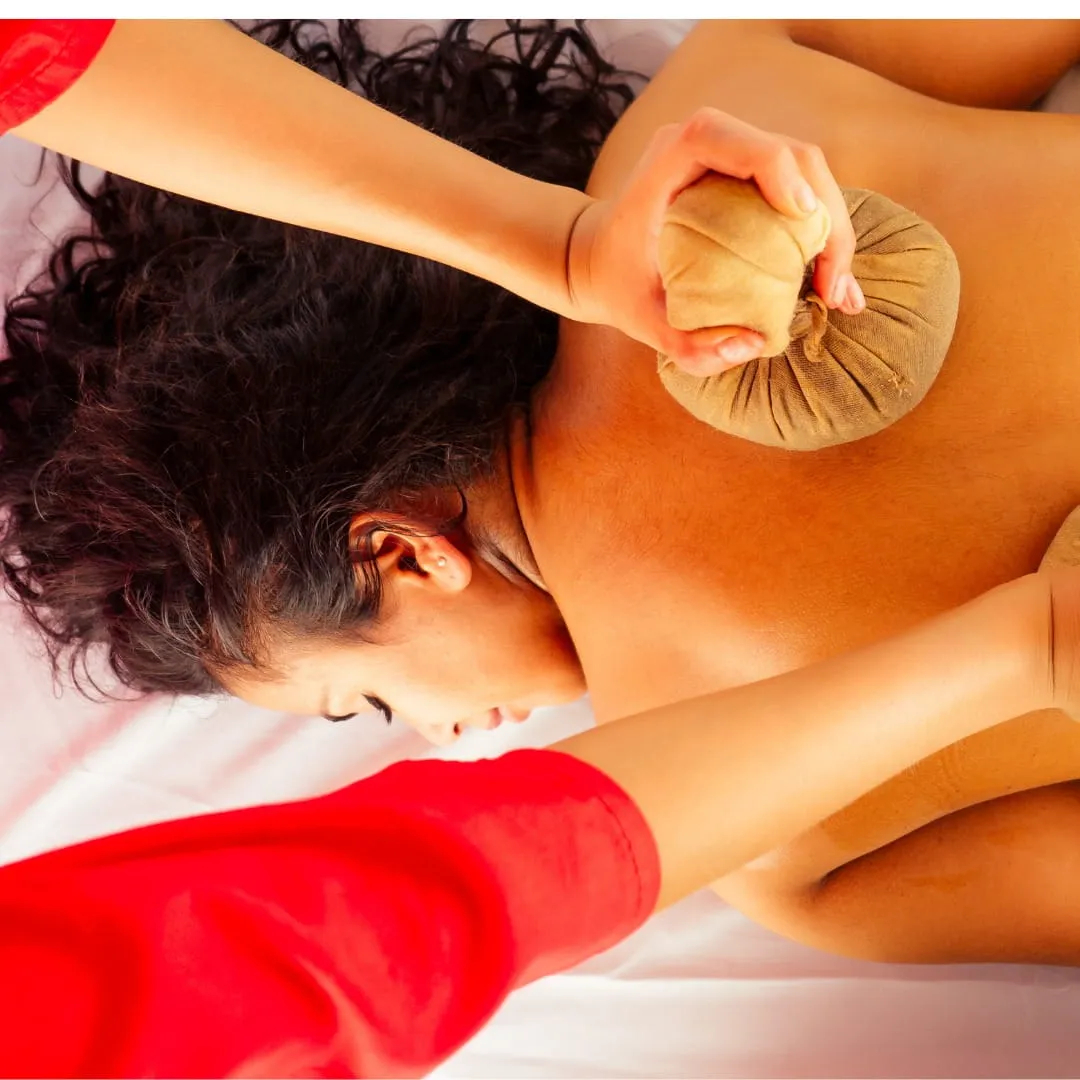
What six weeks of Ayurvedic back pain treatment at Vedara Care looks like in practice.
A representative protocol for chronic mechanical back pain. Your specific plan may vary based on assessment, but this gives you a realistic picture.
Assessment & Foundation
- Initial 45-60 minute consultation with Ayurvedic physician
- Physical examination, history-taking, imaging review
- Joint assessment with physiotherapist (where indicated)
- Pulse diagnosis and dosha assessment
- Written treatment plan with realistic expectations
- Begin internal Ayurvedic medicines
- 2 introductory Abhyanga sessions
Active Treatment Begins
- 4-6 Kativasti sessions (most common protocol)
- 2-3 additional Abhyanga sessions
- 2-4 physiotherapy sessions (if integrated programme)
- Continue internal medicines
- Mid-Week 3 doctor review
Intensive Therapy
- 6-8 Kativasti sessions concentrated in these weeks
- Possible introduction of Patra Pinda Sweda or other adjunct therapies
- Continued physiotherapy
- Refinement of internal medicines based on response
Consolidation & Home Protocol
- Final 2-3 Kativasti sessions
- Comprehensive home protocol: daily self-Abhyanga, dietary plan, exercise prescription
- Final doctor review and discharge plan
- 3-month and 6-month follow-up appointments scheduled
- Internal medicines tapered
This is a representative protocol. Actual treatment plans vary based on specific diagnosis, response to therapy, and patient circumstances. Your plan is written and agreed at consultation, with documented adjustments at each doctor review.
The specific Ayurvedic therapies prescribed for back pain.
Each therapy serves a specific purpose in the protocol. Not every patient receives every therapy — your doctor selects based on your diagnostic pattern.
Kativasti
The targeted lumbar therapy
The cornerstone of Ayurvedic lumbar back pain treatment. Warm medicated oil contained over the lumbar spine in a custom dough reservoir for 30-45 minutes per session. Different oils are used for different pain patterns — Mahanarayana Taila for mechanical pain, Sahacharadi Taila for sciatica. Typically prescribed as a 14-session course over 4-6 weeks for chronic conditions.
Read about Kativasti →Abhyanga
The systemic support therapy
Full-body warm medicated oil massage by two synchronized therapists, addressing the broader Vata imbalance that underlies most chronic back pain. Typically prescribed alongside Kativasti — 2-3 Abhyanga sessions per week during active treatment phase, then weekly maintenance during consolidation.
Read about Abhyanga →Internal Ayurvedic Medicines
The foundational support
Classical Ayurvedic preparations selected for your specific dosha pattern and condition — typically including formulations from the Rasna and Guggulu families (anti-inflammatory and tissue-supporting), and Vata-pacifying medicines. Prescribed as a 6-8 week course with adjustments based on response. Sourced from classical Ayurvedic pharmacies in Kerala with documented quality testing.
Read about Internal Ayurvedic Medicines →Panchakarma
For complex or long-standing conditions
For severely chronic back pain, multi-region pain involving systemic Vata imbalance, or back pain unresponsive to other treatment, classical Panchakarma over 14-21 days addresses the systemic root. Combines the above therapies with Virechana or Basti as the main Pradhanakarma actions.
Read about Panchakarma →For back pain, the strongest outcomes come from combining Ayurveda with physiotherapy.
Chronic back pain involves both tissue-level factors (inflammation, muscle quality, tissue stiffness) and biomechanical factors (posture, motor control, muscle activation patterns, functional movement). Ayurveda primarily addresses the first set. Physiotherapy primarily addresses the second. Patients who receive both — coordinated between the two teams — outperform patients who receive either alone.
At Vedara Care, our Ayurvedic doctors and DPT-qualified physiotherapists share clinical notes for joint back pain patients. A typical integrated week looks like Monday and Thursday for Kativasti and Ayurvedic medicines review, Tuesday and Friday for physiotherapy and movement assessment, Saturday for combined Abhyanga or recovery work.
When we refer you elsewhere first.
Ayurvedic back pain treatment is powerful — but not appropriate for every patient. These are the situations where we send you for conventional workup before any Ayurvedic plan is considered.
If you have any of these symptoms, do not start any treatment — Ayurvedic or otherwise — without first seeing a conventional orthopaedic specialist or neurosurgeon.
- Bowel or bladder incontinence with back pain (cauda equina syndrome — medical emergency)
- Numbness in the genital or saddle region
- Progressive weakness in one or both legs
- Back pain with unexplained weight loss, fever, or night sweats
- Back pain after recent significant trauma
- History of cancer with new back pain
Vedara Care will not start treatment for back pain with these features without conventional clearance. We will refer you and coordinate care.
For these conditions, Ayurveda often supports conventional treatment but is not the primary intervention.
- Acute disc herniation with significant neurological deficit (surgical consult first)
- Recent spinal surgery (post-surgical clearance and rehabilitation phase needed)
- Active spinal infection or suspected tumour (conventional workup essential)
- Severe osteoporosis with vertebral fractures (orthopaedic management primary)
- Inflammatory back pain (Ankylosing Spondylitis, etc.) — alongside rheumatology, not instead of
Real Ayurvedic doctors at our JVC clinic refer to conventional specialists when appropriate. We are integrated with several Dubai orthopaedic, neurology, and physiotherapy practices — and we coordinate referrals when needed.
Real back pain outcomes.
"Three years of chronic lower back pain. Six weeks at Vedara Care. I am playing tennis again."
Sarah K.
Chronic Mechanical Back Pain · 6-Week Integrated Programme · JVC District 12 · February 2026
"My sciatica had radiated down my left leg for eight months. By week four of the Kativasti and Basti programme, the leg pain was gone."
James M.
Sciatica · 8-Week Programme · Dubai Marina · January 2026
"After my caesarean, the back pain was constant for ten months. The 45-day Sukhu programme rebuilt me."
Priya R.
Postpartum Back Pain · Sukhu Pathways · Al Barsha South · March 2026
4.9
stars on Google
142
back pain reviews
89%
reported pain reduction
What Ayurvedic back pain treatment in Dubai actually costs.
Initial Assessment
- 45-60 minute consultation with Ayurvedic physician
- Physical examination and history-taking
- Imaging review (if you bring scans)
- Pulse diagnosis and dosha assessment
- Written treatment plan
- Pricing for full programme provided in writing
Best for: First step for everyone — required before any treatment programme begins
Standard Chronic Back Pain Programme
- Initial consultation included
- 14 Kativasti sessions
- 6 Abhyanga sessions
- Internal Ayurvedic medicines (6-week course)
- Mid-programme doctor review
- Final review with home maintenance plan
- 3-month and 6-month follow-up appointments
Best for: Chronic mechanical back pain, sciatica, spondylosis without surgical indication
Integrated Back Pain Programme
- All Standard Programme components
- 10 additional physiotherapy sessions
- Joint Ayurveda-physiotherapy assessment
- Coordinated weekly schedule between teams
- Comprehensive functional movement programme
- 12-month follow-up support
Best for: Complex back pain, disc-related conditions, multiple-region involvement, patients who want maximum-outcome integrated care
Insurance direct-billing available with seven major insurers — coverage for Ayurvedic chronic pain care varies by plan. WhatsApp us your card before booking to confirm.
What patients ask before starting Ayurvedic back pain treatment.
For specific treatment details, see the Kativasti, Abhyanga, and Panchakarma pages. For physiotherapy alone, see the physio page.
Ask a QuestionVISIT OUR BACK PAIN CLINIC
Expert back pain care in Jumeirah Village Circle.
NEARBY LANDMARKS
- ✓Next to Circle Mall
- ✓3 minutes from FIVE Jumeirah Village Hotel
- ✓5 minutes from JSS Private School
DISTANCE FROM DUBAI COMMUNITIES
Begin with the right assessment.
Chronic back pain deserves more than another generic treatment package. A 45-60 minute consultation at our JVC clinic includes physical examination, imaging review, dosha assessment, and a clear written treatment plan — including honest guidance on whether Ayurvedic treatment is appropriate for your specific condition, or whether you should see a conventional specialist first.
Initial consultation from AED 350 · Joint Ayurveda + Physiotherapy assessment available · Insurance direct-billing · Free clinic parking
EXPLORE FURTHER
Related pages.
Kativasti Treatment in Dubai →
The cornerstone Ayurvedic therapy for lumbar back pain. Read the full protocol, oils used, and what to expect.
Learn morePhysiotherapy in JVC →
For mechanical and structural back pain, physiotherapy alongside Ayurveda delivers the strongest outcomes. See our physio services.
Learn moreAbhyanga Massage in Dubai →
The systemic support therapy used in nearly every back pain protocol. Full description and pricing.
Learn morePanchakarma in Dubai →
For severe or long-standing back pain, classical Panchakarma addresses systemic Vata imbalance. 7, 14, and 21 day programmes.
Learn more