Paediatric physiotherapy in Dubai. Specialised care for infants, children, and adolescents.
Paediatric-trained physiotherapists at our Jumeirah Village Circle (JVC) clinic, walking distance from Circle Mall. Specialised treatment for developmental concerns, sports injuries in children and adolescents, scoliosis, torticollis, cerebral palsy, hypermobility, and other paediatric conditions. Age-appropriate approaches from infants through age 18. Family-involved care that respects your child's pace and personality.
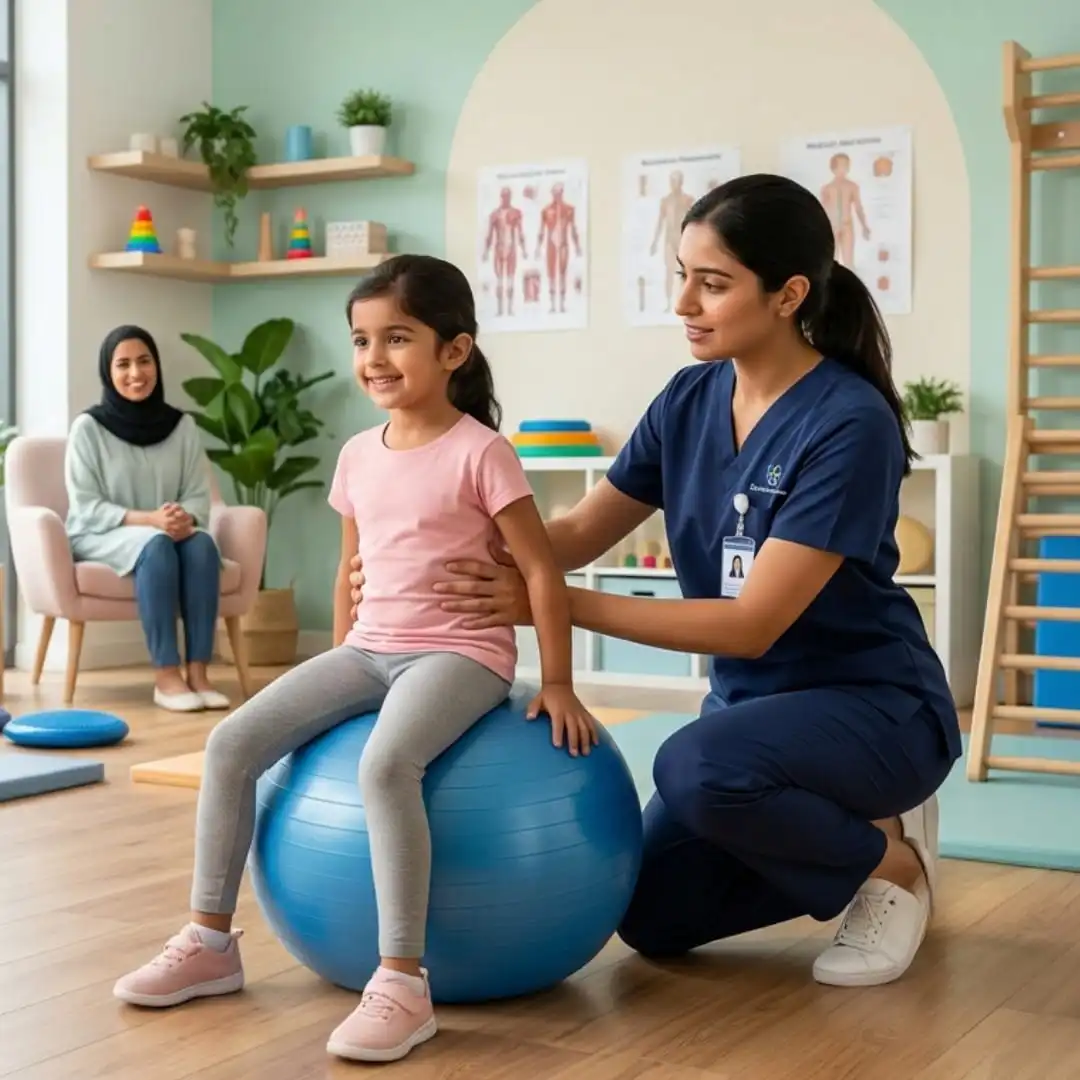
FOUR AGE GROUPS · DIFFERENT APPROACHES
Infants (0-2), preschool (2-5), school-age (5-12), adolescents (12-18). Each age group requires genuinely different physiotherapy approaches — not adult physiotherapy in smaller doses.
THE QUICK ANSWER
Paediatric physiotherapy at Vedara Care, in one paragraph.
Paediatric physiotherapy at Vedara Care Polyclinic in Jumeirah Village Circle (JVC), Dubai — walking distance from Circle Mall — is specialised treatment for children from infancy through age 18, delivered by paediatric-trained physiotherapists with specific expertise across four developmental age groups (infants, preschool, school-age, adolescents). We treat developmental concerns (gross motor delay, walking pattern issues, balance problems), neurological conditions (cerebral palsy, developmental coordination disorder), spinal conditions (scoliosis, torticollis), sports injuries in children and adolescents (Osgood-Schlatter, Sever's disease, growth plate concerns, sports academy injuries), postural concerns, hypermobility, and post-surgical paediatric rehabilitation. Approach is age-appropriate, family-involved, and coordinates with paediatricians, paediatric orthopaedic specialists, schools, and other healthcare providers. Initial consultation from AED 450; structured paediatric programmes from AED 350 per session. Patients travel to our JVC clinic from across Dubai including JVT, Al Barsha South, Sports City, Motor City, Arjan, Dubai Hills, Marina, Downtown, Palm Jumeirah, and Mirdif. Insurance direct-billing with seven major insurers.
Medically reviewed by Dr. Sarah Johnson, DPT, Paediatric Specialist, DHA-Licensed 2509266 · Last updated June 2026
AGE-APPROPRIATE CARE
Four age groups. Four different approaches to physiotherapy.
Children are not small adults. Each developmental stage requires fundamentally different physiotherapy approaches, communication styles, assessment techniques, and family involvement models. Our paediatric physiotherapists are trained across all four age groups.
0-2
Infants
The most specialised paediatric age group — physiotherapy at this age requires specific training in infant assessment, family-centred care, and parent education. Sessions are typically 30-45 minutes with parents actively involved throughout. Conditions are often identified by paediatricians during well-baby visits. The approach focuses on supporting the infant's developmental trajectory through play-based therapy, positioning education for parents, and structured intervention for specific concerns. Family education is as important as direct treatment — parents are with their infant the other 23 hours of the day.
Common conditions:
Congenital muscular torticollis, plagiocephaly, gross motor delay, hypotonia, brachial plexus injury, premature infant developmental support, club foot post-treatment
2-5
Preschool
The age when developmental concerns often become more apparent as children begin walking, running, and engaging in social play. Therapy is play-based — children at this age cannot follow structured exercise protocols, but they can engage in play activities specifically designed for therapeutic purposes. Sessions are typically 45 minutes with significant parental involvement. Cooperation requires building rapport — most children initially resist physiotherapy and learn to engage as comfort builds. The therapist's ability to make therapy feel like play is essential.
Common conditions:
Toe walking, gross motor delay, developmental coordination disorder (DCD), cerebral palsy, hypermobility, post-fracture recovery, balance and coordination concerns
5-12
School-Age
Children at this age can engage with structured therapy approaches while still benefiting from playful elements. Sessions are typically 45-60 minutes. The child becomes a more active participant in their own therapy. Home programmes become possible and important. Coordination with schools matters — physical education accommodation, school sports participation, posture during long school days. Many children at this age develop conditions related to growth (Osgood-Schlatter, Sever's disease) or postural patterns from device use and school posture.
Common conditions:
Osgood-Schlatter disease, Sever's disease, sports injuries from school sports, scoliosis (often detected through school screenings), postural concerns, hypermobility-related pain growth plate injuries, developmental coordination disorder progression
12-18
Adolescents
Adolescents need approach modifications recognising their developing autonomy and self-consciousness. Sessions are typically 60 minutes. The adolescent often becomes the primary decision-maker about their own care alongside parents. Therapy more closely resembles adult physiotherapy with sport-specific or activity-specific protocols. Sports injuries dominate this age group — particularly in Dubai's competitive sports academy environment. Body image and self-confidence considerations are important — adolescents may avoid clinical environments that feel infantilising or, conversely, that feel cold and adult-medical.
Common conditions:
Sports injuries (ACL, hamstring, shoulder, sport-specific patterns), scoliosis (often progressed from earlier detection), adolescent idiopathic spinal conditions, hypermobility-related conditions, post-surgical rehabilitation, postural concerns from device use, athletic performance optimisation
Our paediatric physiotherapists are trained across all four age groups, with depth in particular age ranges. At consultation, your child will be matched with the therapist whose expertise best fits their age and specific condition.
Conditions We Treat
Specific paediatric conditions at our JVC clinic.
Developmental Concerns
Gross motor delay, fine motor delay, walking pattern concerns (toe walking, in-toeing, out-toeing), balance and coordination problems, developmental coordination disorder (DCD), hypotonia, premature infant developmental support, achieving developmental milestones late.
Neurological & Genetic Conditions
Cerebral palsy (all types and severities), Down syndrome physiotherapy support, brachial plexus injury, spina bifida, muscular dystrophy, genetic conditions affecting movement, neurodevelopmental conditions.
Spinal & Postural Conditions
Scoliosis (adolescent idiopathic, congenital, neuromuscular), kyphosis, lordosis, torticollis (congenital muscular and acquired), postural concerns from device use, neck and back pain from school posture, spondylolysis in young athletes.
Sports & Adolescent Sports Injuries
Osgood-Schlatter disease, Sever's disease, sports injuries from academy training (football, gymnastics, tennis, swimming), apophysitis, stress fractures, growth plate injuries, return-to-sport after injury, sports-related back pain in young athletes.
Musculoskeletal & Acute Injuries
Post-fracture rehabilitation, post-cast removal mobility restoration, ankle sprains, knee injuries, wrist injuries, back pain in young athletes, hypermobility-related pain, acute trauma care.
Skull Shape & Infant Concerns
Plagiocephaly (positional flat head syndrome), brachycephaly, infant positioning concerns, neonatal intensive care follow-up, early developmental support.
Did not find your child's condition? Contact us — we treat the full range of paediatric physiotherapy conditions →
How paediatric physiotherapy actually differs from adult physiotherapy.
Paediatric physiotherapy is genuinely a different practice from adult physiotherapy — not just adult techniques applied to smaller bodies. Several principles shape every paediatric session at our JVC clinic.
Play is therapy Children, especially under age 8, cannot engage with structured exercise prescription the way adults can. The exercises that strengthen, stretch, and re-pattern movement must be embedded in play that the child finds enjoyable. This requires creative therapeutic skill — designing activities that achieve specific therapeutic goals while feeling fun to the child. Sessions that look like play to outside observers are precisely calibrated therapeutic intervention.
The parent is part of the team Adult physiotherapy patients perform their home exercises themselves. Children typically need parents to facilitate the home programme. This means parents must understand what to do, why, when, and how to encourage their child without making it feel like punishment. Significant time in paediatric physiotherapy sessions is spent teaching parents — often more important than the direct treatment time with the child.
Children grow — and that changes everything Adult patients have stable bone structure, established movement patterns, and predictable tissue responses. Children are growing — sometimes 8-10 cm in a single year during growth spurts. A treatment that worked at age 9 may need adjustment at age 11. Growth itself can create new physiotherapy concerns (Osgood-Schlatter, Sever's disease, growth-related postural changes). Long-term paediatric physiotherapy involves continuously adjusting to the child's developmental trajectory.
The child's experience mattersIf physiotherapy is traumatic, painful, or boring, the child stops cooperating — often refusing to come back. Effective paediatric physiotherapy requires building genuine rapport with the child, finding their interests, respecting their pace, and making the experience genuinely worthwhile from their perspective. Children remember physiotherapy experiences for years; the way we treat children in our clinic shapes their relationship with healthcare for life.
Coordination with the broader care team Children with significant conditions typically have multiple healthcare providers — paediatrician, paediatric orthopaedic surgeon if surgical involvement, sometimes occupational therapist, speech therapist, special needs support at school. Effective paediatric physiotherapy requires understanding how our role fits into the broader care plan and communicating regularly with the team. We coordinate with paediatricians, schools (with parental consent), and other therapists as needed.
"A great paediatric physiotherapist makes the child want to come back next week. Everything else follows from that."

YOUR FIRST VISIT
What to expect at your child's first paediatric physiotherapy appointment.
Parents often ask what to expect — particularly for children who may be anxious about healthcare visits or for parents who are not sure whether paediatric physiotherapy will help. Here is what actually happens at your first visit.
The initial consultation is 60-75 minutes — longer than typical adult physiotherapy. Time is built in for the child to settle, for thorough family-centred history, for assessment that respects the child's pace, and for parent education at the end.
The first 15 minutes — settling
The therapist greets you and your child, introduces themselves at the child's level, and gives the child time to explore the room and become comfortable. We do not start with formal assessment when a child is anxious — that produces unreliable results and starts the relationship poorly. For very young children, this settling period may be longer.
The next 20-30 minutes — history and observation
Detailed family history with you (often while your child plays nearby and is observed informally). Birth history, developmental milestones, any concerns you have noticed, school or activity context, family history of relevant conditions. Throughout this conversation, the therapist is also observing your child's movement, attention, social engagement, and how they interact with their environment — much of paediatric assessment is observational.
The next 15-20 minutes — formal assessment
Structured assessment appropriate to your child's age and concerns. For an infant: developmental milestone assessment, range of motion, muscle tone evaluation, postural assessment. For a school-age child: movement screening, strength testing, balance and coordination tests. For an adolescent: more adult-like assessment with sport-specific or activity-specific tests. All assessment is framed as games or activities the child can engage with.
The final 10-15 minutes — discussion and plan
Discussion with you about findings, recommendations, and treatment plan. Your child may be playing during this time or, for older children and adolescents, may be included in the discussion. We provide a written summary of findings and recommended treatment plan. If treatment is appropriate, scheduling for subsequent visits is arranged. If we determine that paediatric physiotherapy is not the right intervention for your child's situation, we will tell you honestly and recommend appropriate alternatives.
What to bring
- ✓Your child's medical history summary
- ✓Any paediatrician referral letter
- ✓Imaging or test results if available
- ✓Current medication list
- ✓School performance reports if relevant
- ✓A comfort item for your child (favourite toy, blanket)
- ✓Snack or water for your child
- ✓Comfortable clothing for movement
Who should come
Both parents are welcome at the first visit. If only one parent attends, we suggest the parent who knows your child's medical history most thoroughly. Siblings can come but may need supervision in the waiting area for older children's sessions.
Timing to avoid
How insurance works for paediatric physiotherapy in Dubai.
Paediatric physiotherapy coverage in Dubai insurance plans varies by plan and condition. Generally, coverage is strongest when there is a clear medical diagnosis — particularly when the referral comes from a paediatrician.
What is typically covered well: paediatric physiotherapy with paediatrician referral and documented condition (developmental delay, cerebral palsy, scoliosis, post-surgical conditions, post-injury rehabilitation). Annual session limits vary substantially — some plans allow 12-20 sessions annually; comprehensive plans allow more with continued medical justification.
What may have limits: ongoing maintenance physiotherapy for chronic conditions (often capped annually), preventive or developmental support without specific diagnosed condition, sports physiotherapy for adolescent recreational athletes without specific injury, postural physiotherapy without clear medical justification.
For children with significant conditions (cerebral palsy, muscular dystrophy, scoliosis requiring ongoing care), we help families navigate insurance pre-authorisation, annual coverage planning, and appeal processes when coverage is initially denied. Our experience with the major insurers — Daman, AXA, Allianz, Oman Insurance, Now Health, Bupa, MetLife — helps families maximise their child's coverage.
WhatsApp your insurance card to +971 55 573 6312 before booking, along with any paediatrician referral letter and brief description of your child's concern. Our team will confirm exact coverage and out-of-pocket cost before you commit to a programme.
OUR DIRECT-BILLING INSURERS
- Daman
- AXA
- Allianz
- Oman Insurance
- Now Health
- Bupa
- MetLife
Some children's hospitals and paediatric specialists in Dubai also refer to us for outpatient physiotherapy.
WhatsApp +971 55 573 6312 for coverage confirmation.
WhatsApp UsWe work with your child's broader care team.
Children with physiotherapy needs are typically embedded in a broader care network — paediatrician, sometimes paediatric specialists, often schools, occasionally other therapists. Effective paediatric physiotherapy requires coordination across this network.
Paediatricians and Paediatric Specialists. We work with Dubai paediatricians across major hospitals and clinics — American Hospital, Mediclinic, NMC, Aster, Saudi German, and various private paediatric practices. For children with specific conditions requiring specialist coordination (paediatric orthopaedics for scoliosis, paediatric neurology for cerebral palsy, paediatric endocrinology for growth concerns), we coordinate with the relevant specialists. With your consent, we send progress updates to your child's paediatrician.
Schools. For school-age children, we coordinate with schools when your child's condition affects school participation — physical education accommodations, posture during long school days, school sports participation, special needs support. We work with major Dubai schools including JSS Private School (walking distance from our clinic), Dubai International Academy, Repton, GEMS schools, and various others. Communication typically happens through written reports the parent shares with school, or with parental consent, direct communication with school nurses or special needs coordinators.
Occupational Therapists. Some children benefit from concurrent occupational therapy alongside physiotherapy — particularly children with developmental coordination disorder, sensory processing challenges, fine motor concerns alongside gross motor needs. We coordinate with paediatric occupational therapists across Dubai (we can recommend specific colleagues if your child needs OT but does not yet have a therapist).
Sports Academies and Coaches.For adolescent athletes from sports academies (football academies, gymnastics academies, swimming academies common in Dubai), we coordinate with coaches and academy medical staff when appropriate. Return-to-sport decisions, training load modifications, and prevention programmes benefit from coach awareness.
Other Therapists For children with speech therapy, behavioural therapy, or other specialised support, we coordinate as needed to ensure consistent goals across the care team.
What paediatric physiotherapy at our JVC clinic costs.
| Service | Price |
|---|---|
| Initial paediatric assessment (60-75 minutes) | AED 450 |
| Follow-up paediatric session (45-60 minutes) | AED 350 |
| Infant physiotherapy session (30-45 minutes) | AED 300 |
| Adolescent sports physiotherapy session (60 minutes) | AED 380 |
| Home paediatric physiotherapy session | AED 500 |
| Scoliosis assessment and structured programme | AED 420 |
| Sports injury package (10 sessions, adolescents) | AED 3,400 |
| Developmental support package (12 sessions) | AED 3,900 |
| Cerebral palsy ongoing care (per session, structured programme) | AED 370 |
| Multi-disciplinary case coordination (per case) | AED 250 |
Family pricing available for siblings receiving treatment. Insurance direct-billing with seven major insurers — coverage for paediatric physiotherapy is often substantial with paediatrician referral. WhatsApp your insurance card and referral letter to +971 55 573 6312 before booking.
Real outcomes from our paediatric physiotherapy patients.
Hear from parents whose children have been treated at our clinic — from torticollis in infants to adolescent sports injuries.
"Our daughter was diagnosed with mild scoliosis at her school screening, age 11. Two years of structured physiotherapy at Vedara — same therapist throughout, monthly check-ins, careful progression — and her curve has stabilised. Her paediatric orthopaedic surgeon is impressed. She actually likes coming."
Parent of child with scoliosis · 2-year ongoing programme · Dubai Hills resident · February 2026
"Our son was a toe walker until age 4. Three different paediatricians, lots of conflicting advice. Vedara's team identified the actual underlying pattern and addressed it through structured play-based therapy over four months. He walks normally now. The way they engaged with him made all the difference."
Parent of preschool child · 4-month programme · JVT resident · January 2026
"My adolescent daughter tore her ACL in school sports. The team at Vedara understood adolescent sports recovery — different from adult recovery in important ways. Nine months of structured rehabilitation. Back to school football. The female therapist made the experience comfortable for her as a teenage girl."
Parent of adolescent · ACL Rehabilitation · 9-month programme · Al Barsha South resident · March 2026
5,000+
Patients Treated
4.9
stars on Google
92%
would recommend to other parents
Paediatric specialists at our JVC clinic.
Dr. Sarah Johnson, DPT
Languages: English, Arabi.
Dr. Priya Sharma, DPT
Languages: English, Arabi.
Dr. Maya Al-Rashid, DPT
Languages: English, Arabi.
Dr. Emma Williams, DPT
Languages: English, Arabi.
What parents ask before booking.
For general physiotherapy questions, see our main physiotherapy page.
Ask a QuestionVISIT US
A welcoming clinic for children of all ages.
NEARBY LANDMARKS
- ✓Walking distance from Circle Mall
- ✓3 min from FIVE Jumeirah Village Hotel
- ✓5 min from JSS Private School
- ✓Free patient parking
DISTANCE FROM DUBAI COMMUNITIES
READY TO START?
Your child deserves specialist care — not adult physiotherapy in smaller doses.
If your child has a developmental concern, a sports injury, a postural issue, or any other condition that may benefit from physiotherapy, the first step is a 60-75 minute initial consultation at our JVC clinic. We assess thoroughly, explain findings clearly, design an age-appropriate treatment plan if appropriate, and tell you honestly if we are not the right fit for your child's situation. Same-week appointments typically available.
Initial consultation from AED 450 · Walking distance from Circle Mall, JVC · Five minutes from JSS Private School · Female therapists available · Insurance direct-billing.
EXPLORE FURTHER
Related services and resources.
Physiotherapy in JVC
Our complete physiotherapy department — all seven specialisations including paediatric, team, conditions treated.
Learn moreSports Injury Physiotherapy
For adolescent sports injuries — ACL, hamstring, sports-specific patterns. Some crossover with paediatric care for older adolescents.
Learn morePostnatal Care
For new mothers — 45-day Sutika Paricharya programmes. Some paediatric crossover for infant care.
Learn moreHome Healthcare in JVC
Home physiotherapy services across Dubai including for children with mobility limitations.
Learn more